Guide to Vermont Marriage Records
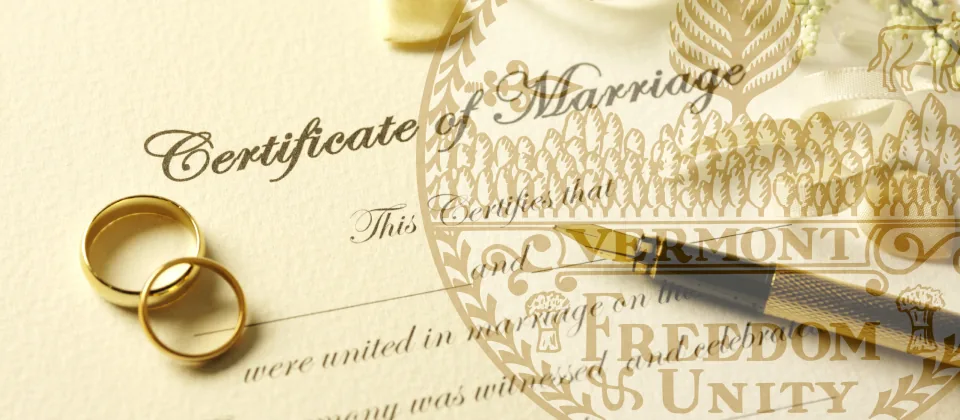
Searching for marriage records in Vermont involves looking up official legal documents that prove two individuals were married in the state. Marriage records usually document the names of the spouses, their birthplaces, the date and location of the marriage, and the name of the officiant.
Often, marriage record documents are confused with marriage certificates and marriage licenses, but each serves a different purpose. A marriage license is the official permission issued by the state to authorize a marriage. The marriage certificate is official documentation that a marriage legally took place in accordance with the law. However, a marriage record is the broader term used to describe the original marriage license application, the license, the marriage certificate, and other documentation maintained on file for a marriage.
Understanding these differences makes it easier to understand why people search for marriage records. Some people search and obtain marriage records for legal purposes, such as processing a divorce, settling an estate, or sorting out health insurance. Others obtain these records to update a legal name with federal and state agencies. Moreover, marriage records serve as a valuable resource for historians working on genealogy projects in Vermont.
Types of Marriage Records in Vermont
| Record Type | Purpose | Issued By | Validation/Notes |
|---|---|---|---|
| Marriage license | Gives a couple permission to marry. | Town or city clerk. | Valid for 60 days. |
| Marriage certificate | Provides legal proof that a marriage took place. | Vermont Department of Health, Vermont State Archives and Records Administration, and authorized town or city clerks. | Certified copies may be used for legal and administrative purposes. |
| Historical marriage records | Used for genealogy and family history searches. | Vermont State Archives, town clerks, FamilySearch, and Ancestry. | Many records dating back to the 1700s are available online. |
Examples of Vermont marriage records include the following:
Marriage Certificates
A marriage certificate is the legal document that establishes that a couple is officially married. It shows a couple's names, the date and place of the marriage, and the signatures of the couple and the officiant.
A certified copy of the certificate is required for certain updates, such as when changing your last name on a passport or a Social Security record. You can get certified copies in Vermont either from the town clerk, where the event was recorded, or from the state Vital Records office.
Marriage Licenses
Before a couple can tie the knot, they must first obtain a marriage license, which is legal approval for a wedding to be performed.
While a marriage certificate is issued only after a wedding takes place, a marriage license is obtained before the ceremony occurs. Vermont marriage licenses are obtained from local town or city clerks and are valid for up to 60 days.
Are Marriage Records Public in Vermont?
Vermont marriage documents are generally considered public documents. However, not all information obtained from couples during the marriage application process is available in public marriage record searches.
Pursuant to the provisions of 18 V.S.A. § 5014, certain information is classified as private and is not open to the public. Information classified as such consists of details about a person's prior marriages, legal guardianship, and elections to dissolve a civil union when that information appears on a marriage license or license application.
Furthermore, any information the state registrar may have marked as confidential for privacy reasons may not be released to the public.
What Information Is Included in a Marriage Record?

The following details are typically available on a Vermont marriage record:
- Full legal names of the spouses (including any maiden names)
- Current residential addresses and birthplaces of both parties
- Full birth names of both sets of parents
- The specific date and town where the marriage happened
- The name, title, and signature of the officiant
- The number of previous marriages or civil unions, if applicable
Note that Vermont protects privacy by keeping certain details private in public marriage records. For example, the spouses' Social Security numbers are not disclosed.
How to Find Marriage Records in Vermont
Step 1: Identify the Marriage Details
Essential information about the marriage is needed before starting the process of finding the records. You should identify the full names of both spouses as well as any known maiden names. Moreover, the wedding date and the town or city where the marriage license was obtained would help.
Step 2: Find the Record Custodian
The next step is to find out which office is responsible for the record. For modern marriages, contact the local town clerk's office where the couple obtained their marriage license. The Department of Health's Vital Records office also serves as the state's central registry for this purpose.
For older marriages, contact the Vermont State Archives and Records Administration (VSARA), which holds both physical and digital records.
Step 3: Choose How to Search
You can locate a Vermont marriage record in a few different ways:
- Online: Vermont operates a vital records request service that allows users to request marriage records for a fee.
- By mail: The Vermont Department of Health accepts mail requests for marriage certificates.
- In person: You can access a marriage record on the same day of request by visiting the town or city clerk’s office where the certificate is on file.
- Genealogy databases: Historical platforms like FamilySearch and Ancestry contain vast collections of older marriage records.
Step 4: Submit a Record Request
After you find the correct custodian of the record, complete the requisite application form. Remember that uncertified copies can serve only as personal references and keepsakes, but certified ones should be obtained for legal or administrative use. You indicate which type of copy is needed.
If you would like to obtain an official certified copy, you will need to provide regular identification, such as a driver's license, and pay the statutory copying fee. A certified copy costs $10, and mailing requests usually take longer than those made in person or online.
How to Get a Certified Marriage Certificate in Vermont
Since Vermont marriage records are generally public, anyone may request a certified copy of a marriage certificate. This request may be submitted to:
- The Vermont city or town clerk who holds the record
- The Vermont Department of Health Vital Records Office
- To the Vermont State Archives and Records Administration for qualifying older records
To request a certified copy of a marriage certificate, you must fill out an official application and provide a clear photocopy of a valid government-issued ID, including but not limited to a driver's license or passport.
Each certified copy of a Vermont marriage record costs $10, payable by cash, credit card, or check, depending on the local town's preference. Note that an online state order includes an additional $2 processing fee.
Individuals who prefer an in-person application may obtain a certified copy of the record within an hour. However, orders made online via approved portals or by mail typically take between one and three weeks to arrive.
Once obtained, certified copies can be used in administrative actions, including insurance enrollment, federal background checks, or estate distribution.
How to Get a Marriage License in Vermont
To obtain a marriage license in Vermont, a couple must complete an application at any clerk's office in the state. Both parties must complete the application form, and at least one applicant must sign the license before the town clerk.
According to Vermont law, both parties must be at least 18 years of age to be eligible for a marriage license. If one of the applicants is under 18, the clerk will deny the marriage license application. An individual who is 18 or older but still under guardianship needs the guardian's written consent.
The fee for obtaining a marriage license is $80, and no state-mandated waiting period exists for marriage-license applicants. In addition, blood tests are not required. Note that once a license has been issued, it must be used within the state's borders during its 60-day validity window.
A valid marriage ceremony must be performed by an authorized individual as per Vermont law. This includes certain judges, justices of the peace, qualified clergy, and individuals registered with the Secretary of State as temporary officiants. Vermont law does not generally require witnesses for a civil marriage ceremony.
After the ceremony, the marriage officiant must complete the certificate and return it to the issuing town or city clerk within 10 days.
Who Can Request Marriage Records?
Since marriage records are part of Vermont’s open public records system, anyone may request them, including:
- The spouses named on the certificate
- Immediate family members (children, parents, or siblings)
- Authorized legal representatives and attorneys managing estates
- Government agencies conducting official business
- Genealogists, historians, and biographical researchers
Despite the public nature of Vermont's marriage records, private information contained in them, such as previous marital information and guardian information, is withheld from public inspection.
Free and Online Marriage Record Searches

Vermont has collaborated with platforms such as FamilySearch and Ancestry to provide access to historical vital records from 1760 to 2008. Specifically, FamilySearch offers a collection titled Vermont, Marriages, 1791-1974, which allows researchers to search by name and other details after creating a free account on the platform.
On the other hand, Ancestry hosts Vermont U.S. Marriage Records, 1909-2008, and an earlier Vermont vital-records collection covering records from the 1700s through 1908. Residents of Vermont may access the state's public records collection on Ancestry for free after completing the site's location verification process.
Note that these free websites allow users to view the names, dates, and images of historical certificates. If a marriage record is required for a legal matter, certified copies must be obtained from the official state or local custodian for a fee and via free online websites.
Researchers using these free online platforms who are unsure of a marriage's date or location may use the central index search tool on the Vermont Department of Health website. This tool allows for conducting a broader search across town registries. Alternatively, they can contact the State Archives at (802) 828-3700 to conduct a more varied search.
Common Law Marriage in Vermont
Vermont does not recognize common-law marriages. Therefore, even when a couple has been living together for several years, sharing responsibilities, and referring to each other as married, their relationship will not be recognized by the state as a marriage. This is because they did not obtain a marriage license or have a wedding ceremony performed by an authorized marriage officiant.
Furthermore, unmarried long-term partners do not automatically inherit property, receive property division, or receive any tax benefits if one partner dies or if the other decides to end the relationship.
However, Vermont respects the established rule of honoring the common-law marriages that originated in other states. This recognition is based on the Full Faith and Credit Clause of the U.S. Constitution. If the couple created a common-law marriage in one of the states that allow it, they will be considered legally married in Vermont, and their marital status will be respected for tax, estate, and legal purposes.
It is important to note that since common-law marriages are not allowed in Vermont, there are no public vital or marriage records that may be obtained from the state or town clerk’s offices as proof of such unions.
How to Correct an Error on a Marriage Record
Errors can exist on Vermont marriage records in the form of an incorrect spouse name, wedding date, marriage location, personal detail, or information provided by the officiant. Typically, either spouse named on the record or a marriage officiant can file a correction request to amend a Vermont marriage record.
The process for correcting a Vermont marriage record generally depends on how much time has passed since the marriage. If an error is noticed within the first six months after the wedding, the correction request may be submitted to the town or city clerk. The clerk is authorized to approve a correction request based on the completed application form and the supporting documentation provided.
Generally, certain documents are required to support a correction request. These documents depend on the type of error to be corrected. Common examples of supporting documentation include a birth certificate, a baptismal certificate, medical records, school records, or other official documents that support the requested correction. Note that, where possible, certified copies of supporting documentation must be provided.
If the clerk refuses the correction, you may ask the probate division of the Vermont superior court to order the change. In addition, if more than six months have passed since the marriage, the certificate can be corrected only by a decree issued by the probate division of the superior court in the district where the original certificate was filed.
There are no statewide-imposed fees or processing times for correcting a marriage record. Note that court costs may apply when a probate division order is involved. Fees vary, and corrections requiring a court order may take several months to process. Once approved, an amended certificate is sent to the town clerk and the Department of Health to correct the master registry.
Marriage Records and Name Changes
A certified copy of a Vermont marriage certificate is commonly required when spouses want to update their names on file in government databases after marriage. For instance, the Vermont Department of Motor Vehicles (DMV) accepts an original or certified marriage certificate as proof of a marriage-based name change. The DMV will not accept a decorative marriage certificate issued only by a religious institution.
Similarly, the Social Security Administration requests a marriage document from applicants seeking a marriage-based name change on their Social Security card. Note that updating couples in Vermont with Social Security records should update their names with the SSSA before applying for a name change on a REAL ID-compliant Vermont license or ID. The state requires individuals to notify the DMV within 30 days of a legal name change.
It is important to note that a name change due to marriage is not the same as correcting a marriage record itself. A name change refers to how a person is identified by agencies and institutions after marriage, while amending a marriage certificate means correcting inaccurate information entered in the original marriage record.
Marriage Records for Genealogy and Family History
Vermont marriage records are essential for genealogists, as they allow researchers to trace ancestral lines even to before the period when modern statewide record-keeping systems were established.
According to VSARA, Vermont vital records are available in online historical collections and cover the years from 1760 to 2008. However, volumes of records covering 1857 to 1868 were transferred to the Vermont State Archives.
The FamilySearch collection provides researchers with useful information on Vermont marriages between 1791 and 1974 if they can provide one spouse's name, even if the town of marriage is unknown.
Besides, Ancestry has two collections that may be useful to genealogical researchers: Vermont, U.S., Vital Records, 1720-1908, and Vermont, U.S., Marriage Records, 1909-2008.
Furthermore, records maintained by town clerks are crucial, as Vermont historically kept vital records at the local level. When a statewide search is unsuccessful, checking a town where either spouse lived can help uncover records that are difficult to locate elsewhere.
Also, researchers should expect some limitations with older marriage records. Some may have spelling errors, incomplete dates, damaged entries, or missing details. Therefore, using other sources such as church records, cemetery records, newspapers, probate files, and census records may help confirm missing details.
Be aware that FamilySearch and Ancestry copies do not reflect corrections or amendments made after 2008.
Frequently Asked Questions
Are marriage records public in Vermont?
Yes. Marriage records are made available to the public in accordance with state law.
How can I find a marriage record by name?
Search FamilySearch or Ancestry using either spouse's name. If you know the town where the license was issued or the marriage took place, you can also contact the town or city clerk directly.
Can I search marriage records online for free?
Yes. FamilySearch provides free access with an account, and Vermont residents can access participating Vermont public-records collections on Ancestry after completing its residency verification process.
How much does a marriage certificate cost?
It costs $10 to obtain a certified copy of the marriage certificate. Orders made through Vermont's online vital-record service have an additional $2 processing fee.
How long does it take to get a certified marriage certificate?
If you apply in person, you may access your marriage certificates the same day at the clerk’s office. Otherwise, it may take about one to two weeks if you apply by mail or online.
Can someone else request my marriage certificate?
Yes. Vermont is an open-records state, which means anybody can get a copy of your marriage records.
What is the difference between a marriage license and certificate?
A marriage license is a legal document issued before the ceremony, allowing people to marry, while the marriage certificate is the legally recognized document issued after the ceremony, indicating that the marriage took place.
Table of Contents
- Types of Marriage Records in Vermont
- Are Marriage Records Public in Vermont?
- What Information Is Included in a Marriage Record?
- How to Find Marriage Records in Vermont
- How to Get a Certified Marriage Certificate in Vermont
- How to Get a Marriage License in Vermont
- Who Can Request Marriage Records?
- Free and Online Marriage Record Searches
- Common Law Marriage in Vermont
- How to Correct an Error on a Marriage Record
- Marriage Records and Name Changes
- Marriage Records for Genealogy and Family History
- Frequently Asked Questions